
Monte Alban Visitor Guide: Oaxaca's Ancient Ruins
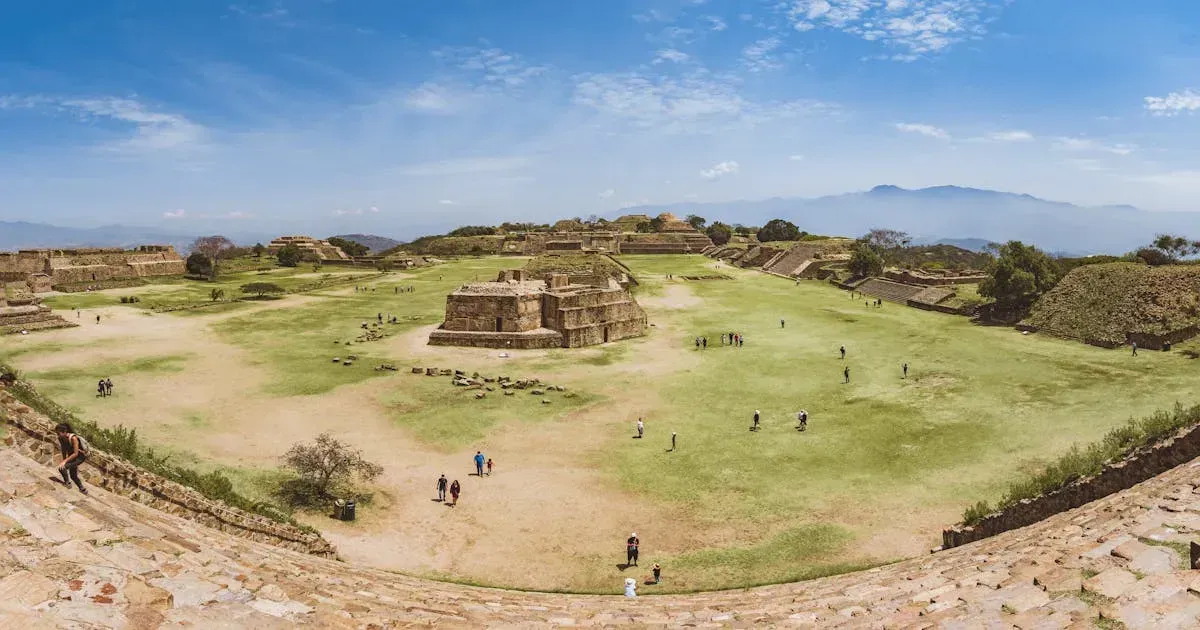
Monte Albán is one of the most important archaeological sites in the Americas and the single most visited attraction in Oaxaca. Perched atop an artificially flattened mountaintop overlooking three valleys, this ancient Zapotec capital flourished for over 1,300 years and was once home to an estimated 25,000 people. Today, its grand plazas, pyramids, and panoramic views make it an essential stop on any trip to Oaxaca.
This guide covers everything you need to know to plan your visit, from the site’s remarkable history to practical details like transport, hours, and what to bring.
A Brief History of Monte Albán
Founding and Early Growth (500 BCE - 200 CE)
Monte Albán was founded around 500 BCE, making it one of the earliest major cities in Mesoamerica. The site was established on a mountain ridge that had no natural water source, which tells archaeologists something remarkable: the founders chose this location for strategic and political reasons, not practical ones. The mountaintop offered a commanding view of the three arms of the Oaxaca Valley — the Etla, Tlacolula, and Zimatlán valleys — and could be seen from nearly everywhere below.
During its earliest phase (Monte Albán I, roughly 500-200 BCE), the inhabitants leveled the mountaintop — a massive engineering feat involving the removal of thousands of tons of rock — and constructed the first ceremonial buildings. The famous “Danzantes” (Dancers) stone carvings date from this period. Originally thought to depict dancers, scholars now believe these carved figures represent slain or sacrificed captives, their contorted poses and closed eyes indicating death or subjugation. This was a city that declared its power through stone.
The Golden Age (200 CE - 700 CE)
Monte Albán reached its peak during Period IIIA (200-500 CE), when it served as the political, economic, and ceremonial capital of the Zapotec civilization. The population swelled to between 17,000 and 25,000 people, who lived on the surrounding hillside terraces while the flattened summit was reserved for temples, tombs, and elite residences.
The city controlled a network of settlements across the Oaxaca Valley and maintained diplomatic and trade relationships with Teotihuacán, the great metropolis near present-day Mexico City. Evidence of this connection can be seen in the architecture and ceramics found at the site.
During this period, the Zapotecs developed one of Mesoamerica’s earliest writing systems and a sophisticated 260-day ritual calendar. Monte Albán was not just a political capital but a center of knowledge and religious practice.
Decline and Abandonment (700 CE - 1521 CE)
After 700 CE, Monte Albán began a slow decline. The population decreased, new construction ceased, and political power shifted to other Zapotec centers like Zaachila and Mitla. By 900 CE, the hilltop was largely abandoned as a living city, though it continued to serve as a sacred burial site.
When the Mixtecs rose to prominence in the region (roughly 1000-1521 CE), they reused Monte Albán’s tombs for their own high-status burials. The most spectacular discovery at the site, Tomb 7, contained Mixtec treasures including gold jewelry, carved bone, jade, and turquoise. These artifacts, now housed in the Museo de las Culturas de Oaxaca in the city, represent one of the richest archaeological finds in the Americas.
UNESCO World Heritage Status
Monte Albán was inscribed as a UNESCO World Heritage Site in 1987, along with the historic center of Oaxaca City. UNESCO recognized the site for its outstanding universal value as “one of the most important examples of Mesoamerican urban planning” and for the exceptional quality of its architectural remains and artistic legacy.
The inscription covers the main hilltop archaeological zone and approximately 2,078 hectares of surrounding protected area, including several satellite sites and unexcavated residential terraces on the hillsides.
What to See at Monte Albán
The main archaeological zone covers the Gran Plaza, a roughly rectangular space measuring approximately 300 meters long and 200 meters wide (984 by 656 feet). The major structures are arranged around the perimeter of this central space, with several buildings placed within the plaza itself.
The Gran Plaza
The vast open plaza is the first thing that strikes you as you enter the site. This enormous flat space, created by leveling the mountaintop, was the ceremonial and political heart of the city. Standing in the center, you are surrounded by pyramids, temples, and platforms on all sides, with the valleys of Oaxaca visible beyond them. The scale is humbling.
The North Platform
The largest structure at Monte Albán, the North Platform is a massive elevated complex accessed by a broad stairway. At the top, you will find a sunken patio surrounded by smaller structures, columns that once supported a roof, and some of the best panoramic views at the site. This was likely the most important ceremonial area in the city.
From the top, look south across the entire Gran Plaza to appreciate the symmetry and ambition of the Zapotec architects.
The South Platform
At the opposite end of the plaza, the South Platform is the tallest structure at the site, rising roughly 40 meters (131 feet) above the plaza floor. The climb is steep but rewarded with the most expansive view at Monte Albán, encompassing all three arms of the Oaxaca Valley. On clear mornings, the views extend to the distant mountains of the Sierra Madre del Sur.
The Danzantes Gallery (Building L)
This structure contains the site’s oldest carved stone slabs, dating from approximately 500-200 BCE. The “Danzantes” (Dancers) are carved figures in contorted poses, many with closed eyes and what appear to be scrolls of blood or entrails flowing from their bodies. Over 300 of these figures have been documented, though many are now copies (originals are in the site museum and the Museo de las Culturas in the city).
These carvings are among the most important examples of early Mesoamerican art and writing, as several include hieroglyphic inscriptions that represent one of the oldest writing systems in the Americas.
Building J (The Observatory)
One of the most unusual structures at Monte Albán, Building J sits in the center of the Gran Plaza at an odd angle relative to the other buildings. Its arrow-shaped floor plan and astronomical alignments have led archaeologists to identify it as an observatory. Carved stones on the exterior are believed to document military conquests by the Monte Albán state.
The Ball Court
Located on the eastern edge of the plaza, the I-shaped ball court is where the Mesoamerican ball game was played. This ritual sport, common across ancient Mesoamerica, had deep religious significance and may have been associated with human sacrifice in some contexts. Monte Albán’s ball court is well-preserved, and you can clearly see the sloping walls that players would have used to keep the heavy rubber ball in play.
Tombs
Over 170 tombs have been discovered at Monte Albán, reflecting its importance as a burial site for Zapotec and later Mixtec elites. Several tombs feature painted murals in remarkably good condition. Tomb 104, which is sometimes accessible to visitors (ask your guide), contains vivid polychrome paintings depicting Zapotec deities and ritual scenes.
Tomb 7, the most famous, is not open to visitors at the site, but its treasures are on display at the Museo de las Culturas de Oaxaca in the city. The gold and jade artifacts found here in 1932 by Mexican archaeologist Alfonso Caso are considered some of the most important pre-Hispanic treasures ever discovered.
The Site Museum
A small museum near the entrance displays artifacts found at Monte Albán, including ceramics, carved stones, and reproductions of tomb paintings. It provides essential context before exploring the ruins. Allow 20-30 minutes for the museum.
How to Get to Monte Albán
Monte Albán is located approximately 9 kilometers (5.6 miles) west of Oaxaca City’s center. There are several ways to get there:
Collective Shuttle Vans
The most popular and economical option. Shuttle vans depart regularly from the Hotel Rivera del Ángel (Mina 518, in the city center). Round-trip tickets cost approximately 80-100 MXN ($4-5 USD). Vans typically leave every 30 minutes starting at 8:30 AM, and you can choose your return time (most visitors choose 2-3 hours after arrival). The ride takes about 20 minutes.
Tip: Buy your round-trip ticket when you arrive at the departure point. Confirm the last return van time so you do not get stranded.
Taxi
A taxi from the city center costs approximately 100-150 MXN ($5-8 USD) one way. Agree on the price before departure. Ask your driver to wait or arrange a pickup time, as taxis do not wait at the site without prior arrangement.
Rideshare (Uber/DiDi)
Both apps work for the trip to Monte Albán, though getting a return ride from the site can be difficult due to limited phone signal and driver availability. Consider using rideshare for the trip up and the collective shuttle for the return.
Organized Tour
Many hotels and tour operators in Oaxaca offer Monte Albán day trips, often combined with other stops like the Arrazola woodcarving village or San Bartolo Coyotepec pottery village. Prices range from 300-600 MXN ($16-32 USD) per person including transport and a guide. The advantage is expert commentary; the trade-off is less flexibility with your time.
Driving
If you have a rental car, Monte Albán is a straightforward drive on a paved road. Free parking is available at the site entrance. Follow signs from the city center toward Monte Albán — the route is well-marked.
Practical Information
Hours
Monte Albán is open daily from 8:00 AM to 5:00 PM (last entry at 4:30 PM). Hours may change during holidays; check with your hotel or the INAH (National Institute of Anthropology and History) website before visiting.
Admission
- General admission: 90 MXN (approximately $5 USD)
- Free admission on Sundays for Mexican nationals and permanent residents
- Video camera permit: An additional 45 MXN ($2.50 USD) if you are using professional video equipment. Standard smartphone and camera photos are included in the general admission.
Guided Tours at the Site
Official guides are available at the entrance and offer tours in English and Spanish. A guided tour of approximately 2 hours typically costs 600-900 MXN ($32-49 USD) for a small group. You can also share the cost by joining with other visitors at the entrance — guides often gather small groups before starting.
A guide is highly recommended, especially for first-time visitors. The site has minimal signage, and without context, it is easy to miss the significance of what you are seeing.
Best Time to Visit
Time of Day
Arrive when the gates open at 8:00 AM. The morning light is beautiful, temperatures are comfortable, and you will beat the tour groups that typically arrive between 10:00 and 11:00 AM. By noon, the hilltop can be hot and crowded, with minimal shade.
If you cannot make it early, the late afternoon (after 3:00 PM) is the second-best option. The light softens, crowds thin, and the views of the valley take on a golden glow.
Time of Year
- Dry season (October-April): Clear skies and comfortable temperatures. This is the best time for photography and visibility.
- Rainy season (May-September): Morning visits are usually rain-free. Afternoon thunderstorms can move in quickly, so plan accordingly. The upside: the surrounding hills are lush and green, creating dramatic landscapes.
- Avoid major Mexican holidays (Semana Santa, November 2) if you prefer a quieter experience, as the site draws large domestic crowds.
Photo Spots
Monte Albán is extraordinarily photogenic. Here are the best spots:
-
South Platform summit: The highest point at the site, offering a sweeping 360-degree panorama. Best in early morning or late afternoon light.
-
North Platform looking south: Stand at the top of the North Platform’s main stairway and look down the length of the Gran Plaza. The symmetry is striking, and the valley provides a dramatic backdrop.
-
Building J from the northeast: The unusual arrow shape of Building J photographs best from an elevated angle on the North Platform side.
-
Danzantes Gallery close-ups: The carved figures are fascinating in detail. Use a zoom lens or close-up phone mode to capture the weathered stone faces.
-
Valley views from the eastern edge: Walk to the eastern side of the plaza for unobstructed views of the Tlacolula Valley with the church domes of Oaxaca City visible in the distance.
Photography tip: The hilltop is wide open with strong sun. A polarizing filter (or your phone’s equivalent setting) will help deepen the sky and manage glare on the stone surfaces.
Essential Tips for Your Visit
What to Bring
- Sunscreen and a hat: There is almost no shade on the hilltop. The sun is strong, especially between 10 AM and 3 PM.
- Water: Bring at least 1 liter per person. There is a small concession stand near the entrance, but prices are higher than in town.
- Comfortable walking shoes: The terrain includes uneven stone surfaces, steep staircases, and gravel paths. Sandals are not recommended.
- A light jacket or sweater: Mornings can be cool, and wind on the hilltop can be surprisingly brisk, especially in the winter months.
- Cash: For entrance fees, guide tips, and the concession stand. Cards are not widely accepted at the site.
What Not to Do
- Do not climb on the structures. This is both a safety hazard and damaging to the archaeological remains. Stay on designated paths and stairways.
- Do not remove anything. Taking stones, pottery fragments, or any other material from the site is illegal and subject to severe penalties under Mexican law.
- Do not fly drones. Drone use is prohibited at all INAH-managed archaeological sites without special permission.
- Do not skip the guide. Even if you are on a budget, splitting the cost of a guide with other visitors is worth the investment. The difference between exploring Monte Albán with and without expert commentary is the difference between seeing old stones and understanding a living civilization.
How Much Time to Allow
Plan for 2-3 hours at the site to explore the main plaza, climb the platforms, visit the museum, and take in the views. If you hire a guide, allow closer to 3 hours. Rushed visits of under 90 minutes will leave you feeling like you missed something — because you did.
Combining with Other Visits
Monte Albán pairs well with afternoon visits to nearby craft villages:
- San Bartolo Coyotepec (black pottery) — 20 minutes south of the city
- Santa María Atzompa (green-glazed pottery) — 10 minutes from Monte Albán, on the road back to the city
- San Martín Tilcajete or Arrazola (alebrijes, carved wooden figures) — 30-40 minutes south
Many organized tours combine Monte Albán with one or two of these villages in a half-day or full-day itinerary. For more options, see our guide to the best day trips from Oaxaca City.
Monte Albán in Context
To fully appreciate Monte Albán, consider visiting the Museo de las Culturas de Oaxaca in the former Santo Domingo monastery before or after your trip to the ruins. The museum’s archaeological galleries provide crucial context: you will see the Tomb 7 gold treasures, Zapotec urns and ceramics, Mixtec codices, and exhibits that trace the cultural history of the Oaxaca Valley from the earliest settlements to the Spanish conquest.
The museum is open Tuesday through Sunday, 10:00 AM to 6:30 PM. Admission is 90 MXN ($5 USD).
The Significance of Monte Albán
Monte Albán is not just a pile of impressive ruins. It is evidence of one of the earliest urban experiments in the Americas — a city built on a mountain with no water, sustained by political will, religious authority, and the engineering ingenuity of the Zapotec people. Walking its plazas, you are walking where astronomers tracked the stars, scribes developed writing systems, and leaders governed a state that lasted longer than the Roman Empire.
In a world where ancient civilizations are often reduced to simplified narratives, Monte Albán challenges visitors to consider the sophistication, ambition, and creativity of Mesoamerican cultures. It is, in the most literal sense, the foundation on which Oaxaca was built.
Whether you spend two hours or half a day, Monte Alban will be one of the highlights of your time in Oaxaca. Go early, hire a guide, bring water, and prepare to have your perspective on the ancient Americas fundamentally shifted. For more on the people who built this city, read about the Zapotec civilization, and check our complete Oaxaca travel guide to plan the rest of your trip.